
By Jessica Johnson, Patrick Wright, Mike Ulrich, Erin Wilson Burns
Main Takeaways:
HR professionals can begin their personal development by answering the question, “What is the most important thing for me to focus on that matters to my stakeholders?” This is what will bring value to the organization.
Creating a personal action plan, to be a more effective HR professional, should focus on one or two of the five new HR competencies outlined in the newest HR Competency Model and an Outside-In HR perspective.
When each HR professional takes responsibility for making progress in an area that matters to its stakeholders, the organization will have a better chance of achieving the desired results.
is true for HR professionals?
Since 1987, University of Michigan Ross School Dave Ulrich and colleagues have been conducting the Global HR Competency Study. This study provides an in-depth look at the competencies of HR professionals that drive personal and business results. We would like to help you delve into the five areas of personal mastery identified in the 8th. round of this study, to generate some ideas for your own development. Perhaps you’ve already received feedback on what you need to improve in a competency domain, or maybe it’s a strength that is so important to your stakeholders that you want to invest in making your skills in this area world-class. Here are some ideas that might help for each of the five domains.
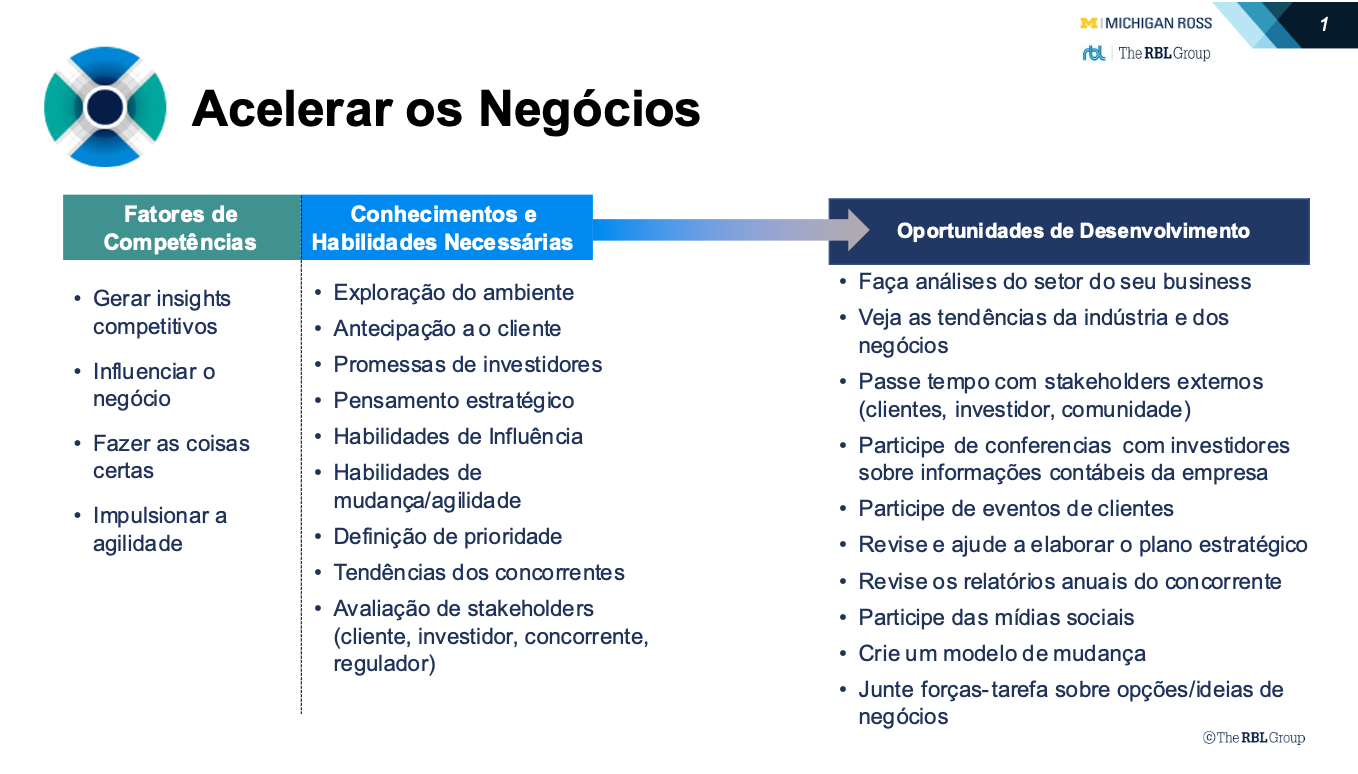
accelerate business
If you are looking to develop your ability to accelerate business, knowing the external environment is crucial. Then you must use what you know to influence the business to do the right things—quickly. This is the necessary basis for your business to remain agile and win in the market. We offer some suggestions to help you focus your personal development in this area:
Become a student of your organization and industry – Remember when you were in college, when you dove into research on a certain subject and learned all you could as you prepared to write a paper? The same tenacity is needed if you want to understand enough of your
business to generate competitive insights and then try to influence people and departments to follow those insights. So subscribe to industry publications, follow thought leaders and CEOs of rival organizations on your social accounts, read your company’s regular shareholder reports (if publicly traded); and do it all with a critical eye on how you can bring together ideas to drive business results.
Change as a way of working – we used to categorize change as an event or something that lasted for a finite period of time. It’s now part of our lives, our organizations, and the way we work every day. With that in mind, taking important steps can help us navigate change as we initiate and then look to sustain it for our organization. Here are seven steps to help develop a stronger discipline around change:
Lead the change – make sure we have strong leadership support behind our initiative and a well-built team to work on the process
Create a felt need – help stakeholders understand the “why” behind the change and feel a connection to the need
Set the direction – clearly communicate the outcome of the initiative in terms of aspiration and action
Engage stakeholders – get buy-in from all the groups needed to deliver the initiative, and communicate with those impacted by it
Decision making – understand the decisions that need to be made and who has the authority to make those decisions, contribute to them, etc.
Institutionalization – align initiative with company technology, HR and finance processes and systems
Monitoring and Learning – Track the success of the change and make adjustments and modifications as we learn from experience
Implementing these seven disciplines – even as a checklist – can lead to more effective change when used consistently across your organization.
Doing the Right Things – In his book Essentialism, Greg McKeown shares the
history of the word “priority”. When it first entered the dictionary, it was singular. There were no such things as multiple priorities. Fast forward to today, where we get into the fruitless game of trying to get everything to the top of our list — making ourselves less effective overall. One development effort you might consider is to sit down at a set time each morning, or even at the end of the day, and review what is most important. What will be your priority for today (or the day after)? Once you’ve made progress on this priority, evaluate and select what’s next. At the end of the day, what you’re working on right now is your priority. If we allow urgent but unimportant emails to distract us from our priority; or someone else’s priority takes us away from our focus; we won’t be as effective at doing the right things. Sometimes your priority will be family, community, exercise, or supporting the strategic initiative your boss has given you. Either way, if you are able to focus your time, effort, and energy on this priority, your progress will be measurable.
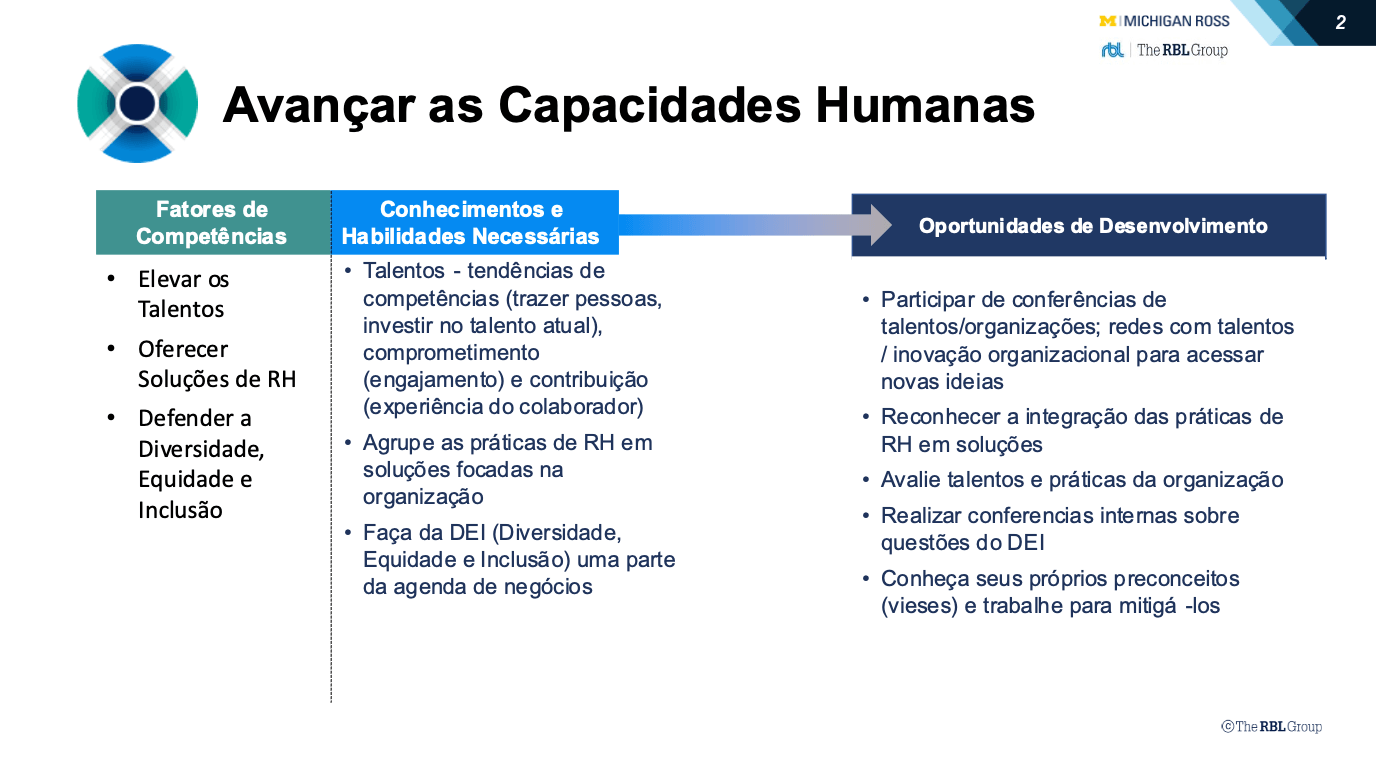
Advancing Human Capabilities
When we consider how we can be better equipped to enhance/advance human capability across the organization, it’s less about knowing the right processes and practices, and more about developing enterprise solutions to elevate talent and help everyone feel connected. You can consider:
Think in terms of combination, not separation – our minds like to process things into smaller pieces. That’s why we break work down into tasks and create to-do lists so we can feel like we’re making progress. There is great value in this within HR if we first make sure that our practices, structures and systems are combined in an integrated way. To advance human capability, we cannot design solutions if distinct teams are working on separate pieces without considering the whole. The opportunity when you’re working on a part is to give voice to the need to combine and make sure we’re not putting bandages on what won’t support a long-term solution. For example, if you’re working on launching a new system to recognize contributors, be sure to connect with stakeholders to understand and align with: how line leaders are awarding awards, what’s available, who’s eligible, how they will be visible to leaders and employees, etc.
Conduct individual pulse assessments on Diversity, Equity and Inclusion – each person carries some bias. This can come from our family of origin, our dominant culture, education, personal experiences and a host of other factors. Our leadership development opportunity is to recognize our bias and then seek to mitigate that bias. Tools like Harvard’s Project Implicit allow you to do a variety of assessments that can help you recognize an implicit preference for one category over another. Also taking the time to reflect on the interactions you’ve had, and the responses you’ve given in certain situations, can help you be more inclusive in your efforts to help everyone feel like they belong.
Elevate the talent around you – there is a consistent need in our organizations for growth and development. In fact, feeling like they’re growing is the number one reason people stay in organizations… and a major factor why they leave if they’re not experiencing personal improvement. One of the best ways to build capacity individually is through coaching. The best coaches are willing to allow the individual they are working with to find their own solutions to the problems they are facing. True coaching is not about giving advice (that’s mentoring), or offering solutions (that’s consulting), but rather partnering with an individual to help them create a plan for moving forward. A coach capable of elevating talent is one who listens deeply, asks many curious questions, holds the individual he is working with accountable for solving his own problems, and then supports him along the path of his choice. Consider the latest developmental conversations you’ve had with direct reports, colleagues, or even your boss. What was your question-to-answer ratio? Did you talk more or listen more? Were solutions offered based on your past experience? Taking the time to personally review these coaching conversations to make sure your role is supportive rather than directive will help you improve your ability to elevate talent.
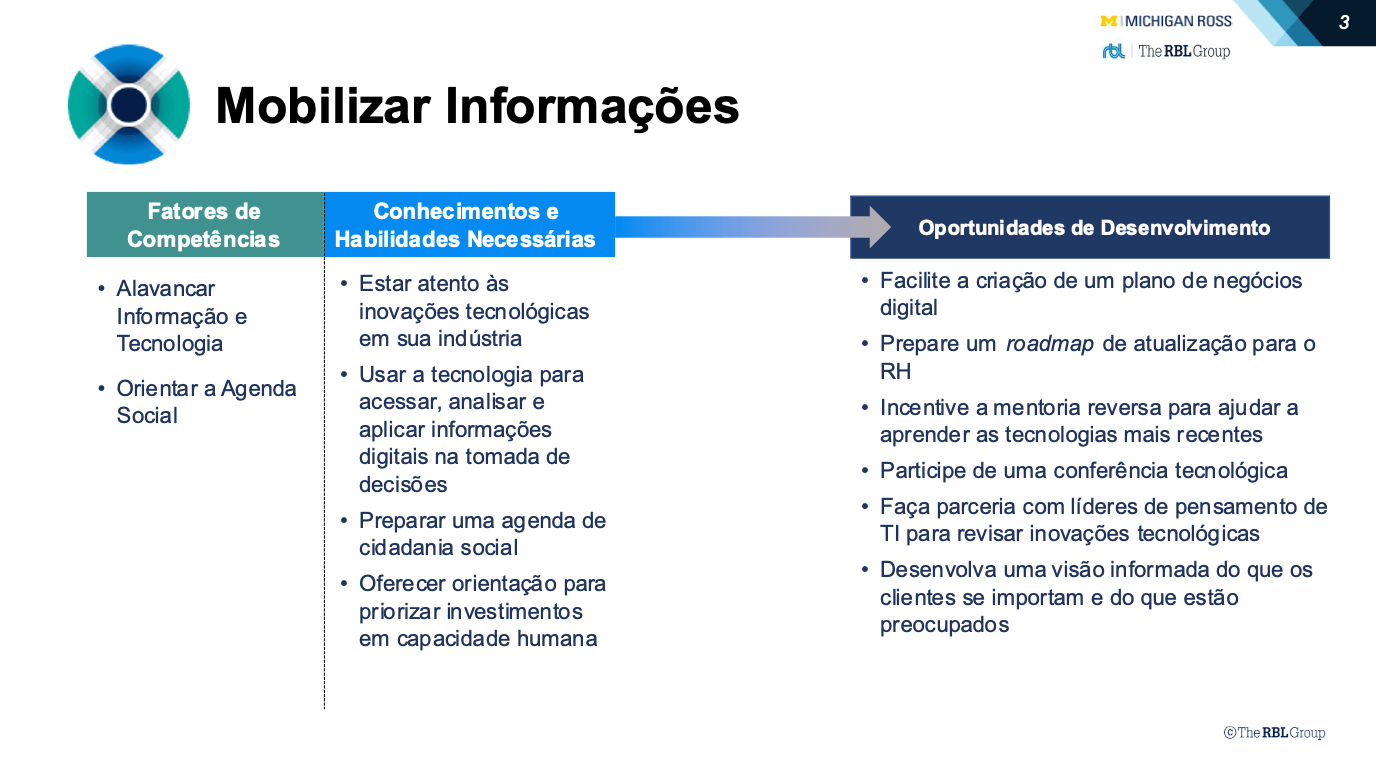
mobilize information
Our next competency focus is around Information Mobilization. HR has improved a lot since our last study five years ago on data collection. We are now awash in data, but are we using that data and our technology to help us solve problems? To do that, we need a mindset shift:
Everyone can be insightful – at Google they have a mantra, that everyone can innovate – even people in the finance industry. In HR we need to develop the mindset that everyone needs to look for insights – through data, experience and observation. We can no longer just have analysts who aggregate data into reports, we need everyone to consider themselves data analyzers. How do you develop this mindset on your own? Practice every day, in and out of the office. (1) Be observant – take a walk, observe colleagues (not in a scary way, just casually), listen for patterns, while discussing what is happening in the organization with various line leaders. (2) Ask questions – curiosity makes us smarter. Don’t assume you know why we do something the way we do, ask to confirm or learn something new. (3) Practice problem solving – don’t just find one solution to fix a problem, invent two or three. Discuss the merits of each with colleagues before introducing them. (4) Assess yourself – at the end of the day, make a quick note to yourself of how many of these behaviors
What does the new HR Competency Model mean for me?
you exhibited. Try increasing this by one a day or one a week.
Connect insights to your business – Earlier we mentioned the need to be a student of your organization and your industry. It’s not enough to just know something, you need to connect it with your organization. If you read about capitalism, AI (Artificial Intelligence), predictive analytics, declining birthrates, etc., do you take the time to ask yourself ‘what does this mean for your company?’ When you listen to a podcast (whether it’s about soft skills, business trends, the global economy, or anything else), take 30 seconds to write down two possible implications of what you’ve heard regarding your organization. If we do this more often, we will develop a stronger point of view about the future and be able to mobilize what we are learning to solve today’s and tomorrow’s problems in our organizations.
promote collaboration
A few years ago, many organizations asked us to train their leaders on how to collaborate better. Back then, when you searched for collaboration on Google, tech solutions came up, but not much about skills that could help. Our research has told us that if you want to foster collaboration, you must build relationships of trust and then use them to decide what to collaborate on and what not to. Not everything is ready for collaboration. It takes time, effort and resources, so we need to be intentional about when we should and even more importantly, when we shouldn’t.
Build trust – we always appreciate simplicity (see next competency). David Maister and colleagues suggested a simple trust formula in their book The Trusted Advisor. He describes that trust includes: credibility, trustworthiness, intimacy/relationship, and perceived self-interest. If we are not in any of these elements, we will have a very difficult time establishing trust. For your own leadership development, you may want to consider a relationship where there are currently issues with trust. Use the formula to diagnose what the problem might be. Do you not believe that the individual can do what he says he can do (credibility)? Were you burned by them because they didn’t deliver on time (reliability)? Do you only talk about work tasks and don’t know anything else about each other (intimacy/relationship)? Or do you think they just want to achieve their goals and don’t care about the organization as a whole (self-interest)? If you can pinpoint a certain area, you can have a better conversation with the individual and/or ask more questions in your next interaction to ensure both sides can trust to collaborate.
Welcome feedback – it’s one of those words that can send shivers down your back: feedback. If you are in a leadership position, your subordinates may not feel comfortable sharing feedback with you or even their peers. Opening a conversation around feedback can work wonders. Just as we’ve talked about practicing mindset shifts on insights before, practicing in and out of the office, the same can be done here. When was the last time you asked a family member for feedback on your performance, your interactions with them, or your responsibilities? When done with a humble attitude and a willingness to really listen and make changes, these conversations can go very well. Start with one thing they suggest you work on (whether it’s family or co-workers), thank them and ask if they have ideas on how you can improve.
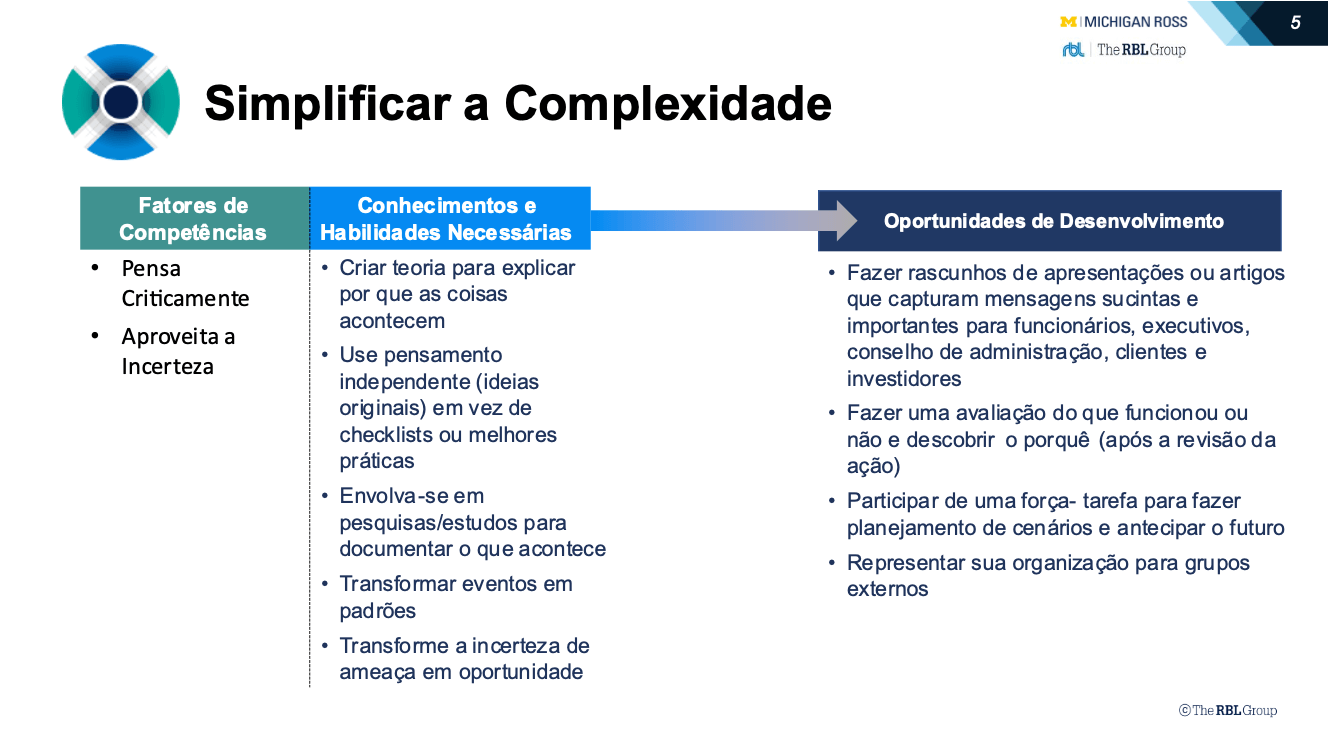
Simplify the Complexity
Finally, a successful HR professional finds ways to simplify complexity for their stakeholders.
Replace fear with fortitude – the last 18 months have taught us that uncertainty is likely to be a part of our daily lives going forward. There are many who fear this uncertainty. In HR, we need to harness it courageously. If things seem to be piling up, or spinning out of control, how can you slow things down? A development idea might be to find a change agent in your organization or through your network – true change agents are not afraid; they really thrive on uncertainty. They are willing to face the wicked problems. Study them, learn their ways, and engage in discussion with them.
Keep it brief – when you are planning to share a project or ideas, place the entire document/slides/presentation as you normally would and then stop. Breathe. And summarize one, two or three main points you want your audience to follow through. Then make an Executive Summary to share and put the rest of your long presentation in the appendix. If your audience wants more, you will. But if not, you’ve just gone through an exercise in finding simplicity through complexity.
We’ve just shared some ideas about personal development for each of the five domains. You can probably think of more. Ask yourself, “What will be the most important thing for me to focus on to add even more value to my stakeholders?” And, “What do they want from me?”
When deciding on your personal development plan to be a more effective HR professional, always keep this “outside-in” perspective of HR handy. In the end, if your stakeholders don’t care about the area you’re developing, then why are you doing it?
RBL is ready to help individuals, departments and companies develop the HR skills that deliver business results.
__
This article has been translated into Portuguese by Being1Group, the original version is available here for your reference. Send us your thoughts or questions about the content of this article at contato@being1group.com